MIKI HOUSE Festival Dolls - Kabuto Helmet
May your child grow up healthy and strong, with the strength and resilience to face life's challenges.
With this wish in mind, MIKI HOUSE presents this Wajima-Nuri Kabuto Helmet.
The Kabuto Helmet, adorned with the dragon, believed to bring good fortune, and the tiger, a symbol of healthy growth, embodies our wish for your child's healthy growth and a fulfilling life.
The Wishes Imbued in the Kabuto
― Dragon and Tiger (Ryuuko)
May your child grow strong, resilient, and forge their own unique future.
With this wish in mind, MIKI HOUSE Kabuto Helmets feature the dragon and the tiger.
The dragon is a being that ascends to the heavens, creating great currents.
It is considered a symbol of wisdom and strength, attracting good fortune and paving the way.
The tiger, with its feet firmly on the ground, protects itself with courage and strength.
It represents the strength to face adversity and the will to protect what is important.
The dragon soaring through the heavens and the tiger standing tall on the earth.
These two forces combine to depict a being that possesses wisdom and courage, resilience and strength.
We want our Kabuto Helmet to be a presence that gently supports and watches over your child as they stride towards the future.
The dragon and tiger designs represent our unwavering wish for your child's healthy growth and happiness.


About Raden
Hachi

Fukigaeshi

About Raden
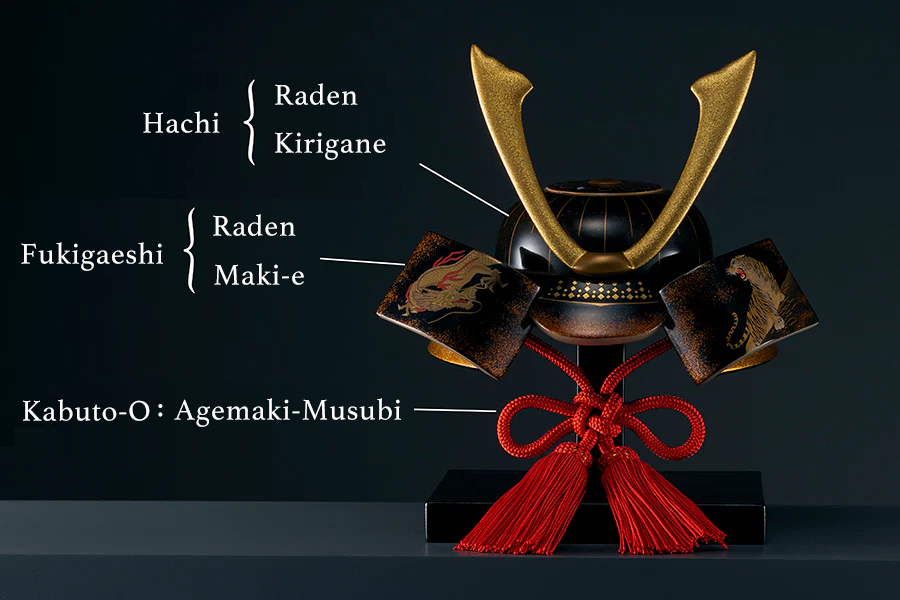
The vibrant design adorning the Hachi, or the helmet bowl, and the gleaming eyes of the dragon and tiger are the result of "raden," a traditional technique incorporated into Wajima lacquerware.
This intricate decoration is achieved by thinly slicing abalone shells and inlaying them one by one into the pattern. The natural luster of the abalone changes its appearance from blue to green to purple depending on the angle of the light, giving off a fantastical, deep-sea-like shimmer against the jet-black background. Raden exudes a quiet presence without being overly flashy. It is a mysterious and dignified beauty born from the fusion of natural materials and the craftsmanship of artisans, imbued with tradition.
About Kirigane

About Kirigane
The design used on the front of this helmet is "kirigane," one of the decorative techniques used in Wajima lacquerware.
Gold plates, made by layering and firing gold leaf, are individually cut into diamond shapes and carefully arranged, creating a beautiful, three-dimensional design. Kirigane is an extremely delicate and highly skilled technique that involves cutting gold leaf and plates into miniscule shapes and carefully arranging them with great precision, considering even the slightest differences in size and angle. The finished product largely depends on the concentration and skill of the craftsman. The finely-cut gold softly reflects light, giving off a luxurious yet quiet elegance and the deep, nuanced expression unique to Wajima lacquerware.
About Maki-e

About Maki-e
The dragon and tiger that adorn the helmet.
The dragon's body, almost lifelike, and the tiger's beautiful coat are rendered using "maki-e," one of the principal decorative techniques of Wajima lacquerware.
Maki-e is a technique in which patterns are painted with lacquer, followed by gold powder or leaf sprinkled on top to affix them in place.
In Wajima lacquerware's maki-e technique, the skillful use of gold particles of different sizes allows for a deep, complex, three-dimensional expression.
The movement in the tiger's coat and muscles, and the texture and dynamism of the dragon's scales are meticulously depicted using multiple types of gold powder of different particle sizes.
The luster of the gold is not uniform; its intensity varies in different areas, creating a delicate expression within its powerful presence.
This decorative technique highlights the profound allure of Wajima lacquerware, even reflecting the powerful presence of life itself.
About Kabuto-O

About Kabuto-O
The kabuto-o cord is not just decorative; it is a significant design symbolizing the binding of wishes for your child's healthy growth. Made with high-quality silk thread and specially dyed in signature MIKI HOUSE red, the cord adds a touch of elegance befitting the festival celebration.
The knot used is the Agemaki-Musubi, a traditional Japanese decorative knot that symbolizes bringing good fortune and warding off evil.
Within strength, there is gentleness and prayer.
MIKI HOUSE Meets
Wajima-Nuri Lacquerware
The Secret Behind Wajima-Nuri's Durability
Festival Dolls
Standing Hina Dolls and Kabuto Helmet
MIKI HOUSE Standing Hina Dolls
Okuizome Meal Set / Feeding Set
